Japan Real Time Charts and Data

Edward Hugh is only able to update this blog from time to time, but he does run a lively Twitter account with plenty of Japan related comment. He also maintains a collection of constantly updated Japan data charts with short updates on a Storify dedicated page Is Japan Once More Back in Deflation?

Thursday, December 06, 2007

Japan Index of Leading Indicators October 2007

Well, perhaps the only positive thing that can be said about the latest release from the Cabinet Office of the Index of Leading Indicators is that it is above last months zero reading. The index, which is Japan's broadest indicator of the outlook for the economy was in contraction mode for a third consecutive month, a signal that growth may well be stalling. The leading index was at 20 in October, and any reading below 50 indicates the economy may slow three to six months ahead.


The leading index is derived from 12 monthly indicators including housing starts, stock prices and other statistics that are a barometer for future economic activity. For a component to be negative, it has to be weaker than it was three months ago.

Housing starts dropped 35 percent in October, the fourth monthly drop, after a rule change to make building approvals more difficult choked off applications just as the sub-prime credit crunch was gaining global momentum. Housing investment was the biggest drag on Japan's growth in the three months ended on Sept. 30, and looks like continuing to be one in the present quarter. At the same time household spending growth slowed to 0.6 percent in October from 3.2 percent in September.


Just for the record it is worth reminding ourselves that Japan has had three recessions since the stock and property market bubbles burst in the early late 1980s early 1990s. The first of these lasted 32 months from March 1991 to October 1993, and the second dragged on for 20 months from June 1997 to January 1999. The most recent recession was in the 14 months from December 2000, when the bursting of an information-technology bubble damped exports and capital investment. So remember, Japanese recessions, should we ultimately get one, are now long and hard affairs.

Monday, December 03, 2007

Japan Company Capital Spending Q3 2007 and Japanese Wages in October

Japan's companies cut spending for a second quarter between July and September according to data from the Finance Ministry today. Capital spending fell 1.2 percent in the three months ended 30 Sept 2007 (when compared with Q3 2006) after a 4.9 percent year on year drop in the previous quarter.


Profit at the 24,000 companies surveyed fell for the first time in five years, giving them less cash to invest in equipment and personnel in coming months. At the same time Japanese wages failed to rise in October, as measured by average monthly total cash earnings according to the provisional Monthly Labour Survey released today (they were unchanged year on year) giving a further sign that domestic consumers may be unable to pick up the slack left by falling exports to the U.S. - still (despite considerable diversification) Japan's biggest overseas market.

Friday, November 30, 2007

Japan Building Construction Starts November 2007

Japan's housing starts fell for a fourth month in October as stricter rules for obtaining building permits and the impact of the US sub-prime credit tightening continue to place a burden on economic growth. Starts tumbled 35 percent in November from a year earlier after falling 44 percent in September, the Ministry of Land Infrastructure and Transport said in Tokyo today.


The government eased regulations earlier this month in an attempt to prevent the slump from derailing growth after housing investment became the main drag on the economy in the third quarter. Loan relief to small companies hurt by the new rules will also be provided, the government said, after bankruptcies in the construction sector swelled by a fifth last month.

http://www.bloomberg.com/apps/news?pid=20601101&sid=aJ_nAS3VHcec&refer=japan

On an annualized basis, housing starts rose to 850,788 units from September's four-decade low, the report showed. It was the first increase in four months.

Japan altered the building code on June 20 after an architect fabricated earthquake-resistance data in 2005. Builders complained that the new system was introduced too fast, they didn't have time to adapt to the requirements and it was difficult to get approvals for any changes to plans.

Government officials and some economists are saying that the worst may now be over for the industry. The building-approval rate doubled to 50 percent in October from a month earlier, Land Minister Tetsuzo Fuyushiba said this week, and the approval rate for submissions through Nov. 23 rose to 71 percent, the ministry have said.

Still, all this needs monitoring carefully, since the decline in housing investment has already shaved a significant amount from Japan's 2.6 percent annual expansion rate achieved in Q3.

Japan Retail Prices, Employment, Income and Consumption October 2007

Japan's economy showed its first signs of inflation this year after food and energy prices both rose in October. Core consumer prices, which exclude fresh food, climbed 0.1 percent in October from a year earlier, the first increase since December 2006, the statistics bureau said today in Tokyo, while the index excluding food and energy continued to fall (by 0,3%).


Claus - who is busy with exams at the moment - normally covers this area here, so I will simply say that I doubt very much that this small rise will be enough to have any significant impact on Bank of Japan thinking about interest rates as the U.S. economic slowdown and financial-market turmoil cloud the outlook for growth, and the employment and earnings outlook in Japan continue to remain weak. I fuller examination of Japan's recent inflation dynamics can be found in this post from Claus examining the September data in detail.

Turning now to employment, the headline data is that the unemployment rate stayed at 4 percent in October after rising in each of the two previous months.


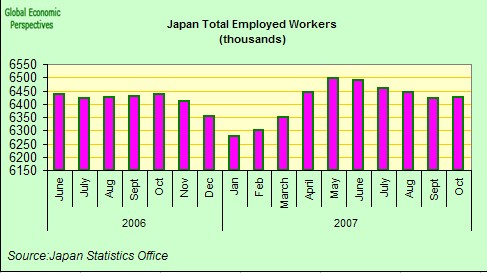
The rate has risen from a nine-year low of 3.6 percent in July. The number of jobs available for each applicant had the steepest decline in six years. Also worthy of note is the fact that the total number of employed persons in October 2007 was 64.24 million, a decrease of 130 thousand or 0.2% from the October 2006. As we can see in the chart the total number of those employed has been declining steadily since the peak in May. More detailed analysis of the current labour market dynamics will have to await the publication next week of October's edition of the Monthly Labour Survey.


For two-or-more-person households, the statistics office have also announced that the annual rate of increase in household spending slowed in October to 0.6 percent from 3.2 percent in September.


For workers households, average monthly income per household stood at 469,981 yen, up 0.6% in nominal terms and up 0.4% in real terms from the previous year.